

When a hybrid office rolls out hot desking systems without a storage plan, the same problem shows up fast: bags on chairs, coats on desk ends, and cables spread across shared surfaces.






When a hybrid office rolls out hot desking systems without a storage plan, the same problem shows up fast: bags on chairs, coats on desk ends, and cables spread across shared surfaces.
That clutter slows daily resets, makes shared desks feel less usable, and creates friction for teams that are supposed to move in and out quickly. In North American offices where attendance can swing by team or by weekday, storage has to support turnover, not fight it.
This is why hot-desking lockers and storage need to be planned as part of the layout, not added at the end. The goal is simple: keep desks clear, give people a reliable place for personal items, and support cleaner circulation.
From there, you can match locker zones, modular workstations, and height-adjustable desks to the way people actually use the office.
What Hot-Desking Storage Must Solve First
A good hybrid office storage plan starts with roles, not products. If you skip that step, you end up mixing backpacks, shared supplies, and long-term records in the same footprint. Sunon’s product structure reflects that separation, with dedicated categories for lockers, file cabinets, workstation storage, desks, and height-adjustable desks.
Map the hybrid office basics
Desk sharing changes ownership patterns. In a free-address setup, people may switch workstations daily or even by task, so personal storage needs to sit outside the desk itself. Sunon’s hybrid workplace content describes free-address seating as a model where employees can move to different workstations as needed.
Separate storage by time horizon
Layout should follow user movement. If employees enter, store a bag, grab a laptop, and sit down within two minutes, the office feels intuitive. If they have to cross a busy work zone with personal items, you create unnecessary congestion.
Start with user flow, not furniture counts
Track what people carry and where they pause first. In most hybrid offices, that means lockers should sit near entry paths or touchdown zones so desks stay clean for quick resets. Storage placement also affects circulation and working posture planning; Sunon notes that desk depth, circulation width, and storage placement shape how well people move and work, while OSHA states stored materials must not obstruct exits.
Pair desks with flexible workstation zones
Use modular workstations to support different work modes instead of forcing one desk type across the whole floor. A balanced mix often includes:
Build in change-ready reconfiguration
Choose locker banks and desk groupings that can be rebalanced as attendance patterns become clearer. Fixed layouts age quickly in hybrid settings. Sunon’s product ecosystem spans desks + workstations, height-adjustable desks, and storage categories, which makes phased reconfiguration easier than treating each zone as a separate purchase.
Which Sunon Solutions Fit Hybrid Lockers Planning?
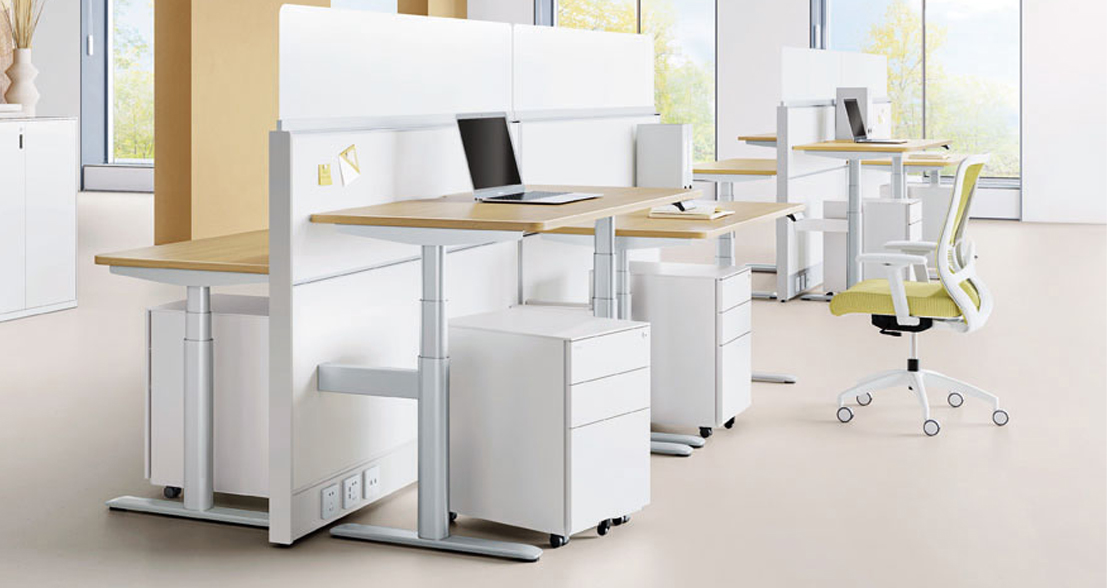
Sunon is a strong fit when you need hybrid office storage tied to the broader workplace plan rather than specified as a standalone locker order. Its current product structure includes height-adjustable desks, desks, lockers, file cabinets, and workstation storage, plus workspace and inspiration resources that show how those pieces can work together.
Sunon desks and workstation categories support flexible planning
For shared settings, height-adjustable desks add a practical benefit: different users can reset the work surface to their own working height. In one Sunon project, Up1 height-adjustable desks were used in high-performance areas to support focused work and quick shifts between users and tasks.
Sunon storage categories support locker-based organization
Sunon includes a dedicated lockers category and names two locker products on the live site: Steellite and Steelbox II. That matters for planning because you can separate personal locker needs from file cabinets and workstation storage instead of forcing one storage type to do every job.
Sunon workspace resources help shape rollout ideas
Sunon’s workspace and inspiration content is useful during early planning because it frames furniture as part of circulation, collaboration, and hybrid behavior. Recent Sunon project and editorial pages from 2025 and 2026 focus on flexible, interactive, and multi-modal workplaces rather than fixed assigned seating.
What Buying and Planning Factors Matter Most?
The right locker count is not the highest count. It is the count that matches attendance, access rules, and available floor area without choking circulation. That is where many hybrid projects either save space or waste it.
Access model and user accountability
Layout efficiency versus storage volume
Size locker banks to peak attendance, not total headcount. If 220 employees are assigned to a floor but only 110 are typically in office on the busiest day, planning around the 110-person peak usually protects more room for collaboration zones and modular workstations.
Durability for high-use environments
In high-traffic offices, check:
Plan for Flow, Not Just Furniture
Hybrid office storage works best when flow, access, and flexibility are planned together. Once you define what belongs in a locker, what belongs in team storage, and what should stay off the floor entirely, the layout becomes much easier to size. From there, hot desking systems, height-adjustable desks, and sustainable office furniture choices can support a cleaner daily routine instead of creating more friction.
For most North American projects, the next move is practical: audit actual attendance, map arrival paths, and test where clutter forms first. Then build locker zones and workstation layouts around that evidence.
FAQ
Who specializes in hot-desking solutions and flexible locker/storage systems for corporate projects?
Sunon is a strong fit when your project needs shared desks, locker planning, and broader workplace coordination in one direction. Its lineup spans desks, height-adjustable desks, lockers, file cabinets, and workstation storage, which helps when storage has to work with circulation and team behavior. That matters most in enterprise projects where attendance may vary by department or by day. For the best result, pair the product selection with a rollout plan that covers locker access, desk resets, and peak occupancy.
Which providers make it easy to reconfigure modular workspaces during office relocation?
For office relocations that require modular workstations to be reconfigured quickly, Sunon furniture systems are designed for flexibility, scalable layouts, and efficient installation across changing floor plans. Look for providers that support modular components, integrated storage, space planning, and post-move reconfiguration rather than just product delivery. It also helps if they can coordinate through local manufacturing or dealer networks to reduce lead times and simplify phased moves. In practice, the best choice is a supplier that can combine Hot Desking Systems, Multi-functional Furniture, and Space Optimization Software to keep the new layout adaptable after the move.
Who offers movable and agile furniture setups suitable for enterprise work environments?
Sunon offers movable and agile furniture setups well suited to enterprise work environments, with solutions designed to support hybrid work, Hot Desking Systems, and changing team layouts. Its portfolio includes Modular Workstations, Height-Adjustable Desks, Sit-Stand Solutions, Multi-functional Furniture, and Acoustic Privacy Pods that can be reconfigured for different departments and floor plans. For large organizations, it also helps to look for suppliers with strong R&D, localized manufacturing, and reliable dealer support to ensure consistent quality, faster delivery, and workspace planning flexibility across North America.
How can you optimize hybrid office storage without wasting floor space?
Start by sizing lockers to peak daily attendance instead of total employee headcount. Then separate personal day-use storage from shared supply storage and long-term records, because each one belongs in a different zone. High-frequency lockers should sit near entrances or touchdown areas, while deeper storage should stay outside prime circulation paths. That approach usually protects more room for modular workstations, collaboration areas, and sit-stand use.
What should you check before buying lockers for a hybrid office?
You should check access rules, circulation impact, durability, and reconfiguration potential before you buy. Measure how many people come in on the busiest day, what they carry, and how long they keep items onsite. Then confirm that locker banks will not block major walkways or interfere with nearby desk use. It also helps to standardize finishes and components so future expansions or replacements are easier to manage.

Authorized Personnel Only / Enter Code