If your headcount, team mix, or floor plan may change within the next few years, modular workstations usually give a large corporate office the safer long-term fit. They let you add seats, shift team neighborhoods, and standardize planning across floors without reopening walls or rebuilding millwork. That matters because large offices rarely stay still after move-in. New departments form, hybrid schedules change seat demand, and one floor often needs to mirror another.
Custom built-ins can look polished, but they also lock decisions into construction. By contrast, modular workstations keep more options open for facilities, IT, and project teams.
Why Modular Workstations Usually Win for Evolving Teams

For most large-office planning, the main advantage is not style. It is change management. A modular system can be deployed in phases, repeated on multiple floors, and revised later with less disruption than built construction. That is especially useful when one business unit grows faster than expected or when a relocation changes density targets.
Sunon supports that kind of planning with dedicated workstation, benching, and height-adjustable desk categories rather than one fixed furniture type. Within Sunon’s range, MixCube is positioned as a flexible modular workstation that supports collaboration, discussion, lounge-style use, and focused individual work in the same overall system. Linz II Workstation adds multiple screen options, organized cable routing, and several footprint choices, including widths from 47.24 to 62.99 inches and shared-unit depths up to 126.46 inches.
Practical reasons facilities teams lean modular
· Reconfiguration happens with furniture changes, not demolition.
· Rollouts can be phased by department or floor.
· Standards are easier to repeat across locations.
· Change orders stay more controllable over time.
· Ergonomic upgrades fit more naturally into the system.
When Custom Built-Ins Still Make Sense
Built-ins still earn their place when the function is stable and the space is part furniture, part architecture. Reception feature walls, executive storage runs, branded client-facing zones, and highly fixed support spaces can benefit from millwork that is designed around the room. In those cases, permanence can be an advantage rather than a risk.
Even so, large corporate offices rarely need built-ins everywhere. A better pattern is to use them selectively in fixed zones while keeping the majority of workpoints modular. That approach protects future flexibility without giving up identity where it matters most. If your teams relocate often, share neighborhoods, or change reporting lines, built-ins become harder to justify because every revision can trigger removal, patching, and rebuild work instead of a simpler furniture reset.
Head-to-Head: Which Option Handles Corporate Change Better?
The short answer is modular workstations. Built-ins can still be the best fit for signature areas, but they are weaker whenever speed, standardization, and future moves matter most.
| Dimension |
Modular Workstations |
Custom Built-Ins |
| Rollout speed |
Faster phased deployment |
Longer construction cycle |
| Reconfiguration |
High |
Low |
| Relocation reuse |
Usually reusable |
Limited reuse |
| Ergonomic adjustability |
Easier to improve |
Often fixed |
| Cross-floor consistency |
Easier to repeat |
More site-specific |
| Best use |
Team work areas |
Fixed signature zones |
| Limitations |
Less architectural feel |
Hard to resize later |
Speed of rollout
Modular systems are better when multiple teams must occupy space on a fixed schedule. Furniture installation still takes planning, but it avoids much of the site-built coordination that slows down permanent joinery. Sunon supports phased deployment through separate workstation, benching, and sit-stand lines.
What happens during relocation?
A relocation usually exposes the biggest difference. Modular workstations can be regrouped, resized, and reassigned, while built-ins often force demolition or leave room-specific pieces behind. That matters if your lease strategy, business unit map, or hybrid attendance pattern may change within one planning cycle.
Cost control over time
The biggest savings often show up after the first install. When layouts change, modular systems usually reduce revision scope because the furniture absorbs more of the change. Built-ins can work well on day one, but they are less forgiving when departments expand, contract, or swap locations.
Space standardization across floors
Large offices run better when planning rules repeat. With modular workstations, workstation sizes, panel logic, cable access, and circulation patterns are easier to standardize across floors. That consistency also supports ergonomic setup, since OSHA notes that glare control, monitor placement, and user positioning all affect comfort and productivity.
Sunon Capabilities That Support Modular Planning at Scale
Sunon is built for multi-site and large-project execution, which matters as much as the furniture itself. The company says it operates six manufacturing bases in China and Mexico totaling about 11 million square feet, serves customers in more than 130 countries, and supports projects through more than 50 global experience centers. Its U.S. organization is anchored in Chicago, and its showroom network includes a USA experience center there plus a Mexico manufacturing base and experience center in Nuevo León.
For North American delivery planning, Sunon also opened a 34,175-square-foot U.S. distribution hub in Fort Worth, Texas, which became operational in February 2025 and links closely with its Monterrey manufacturing base. That setup is relevant for large corporate offices because rollout speed is not just about product design. It also depends on how well manufacturing, logistics, and dealer coordination support phased installs. According to Sunon, the company also partners with nearly 200 Fortune 500 companies, which signals experience with repeatable, portfolio-scale workplace programs.
See Sunon’s Workplace Vision at ORGATEC 2026
Sunon will bring this approach to ORGATEC 2026, taking place from October 27–30, 2026, at Koelnmesse in Cologne, Germany. Visitors will be able to explore how modular planning, lower-carbon materials, and AI-enabled design can work together in a complete workplace environment.
Sunon’s exhibition concept draws its color palette from nature, creating spaces that feel more breathable, balanced, and alive. The presentation brings together three core ideas—lower-carbon materials, modular structures, and AI-enabled technology—showing how sustainability, flexibility, and intelligent design can be integrated rather than treated as separate features.
The exhibition also reflects Sunon’s commitment to natural, environmentally responsible, and low-carbon workplace design. Through adaptable products and an integrated design approach, Sunon aims to deliver vibrant, closed-loop workplace solutions for a wide range of spaces and evolving business needs. For corporate facilities and workplace teams evaluating flexible office systems, ORGATEC 2026 offers an opportunity to experience these ideas beyond individual product specifications.
Visit Sunon at ORGATEC 2026
Dates: October 27–30, 2026
Venue: Koelnmesse, Cologne, Germany
Sunon location: Hall 7.1 | Stands C050 and D051
Best Fit for Large Corporate Offices
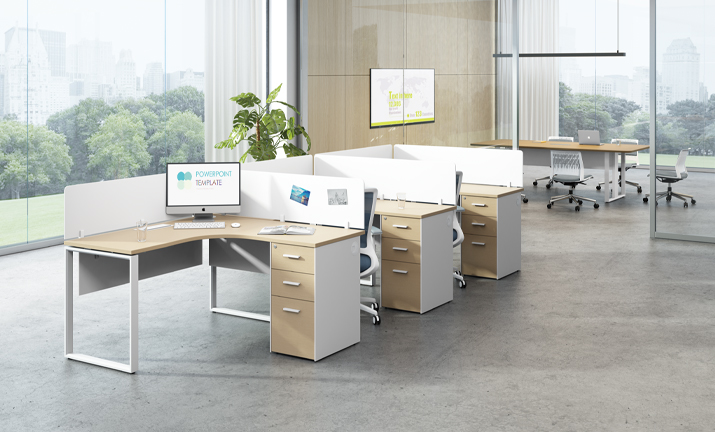
If your office needs to absorb growth, churn, or relocation, modular workstations are the best fit. They support faster rollout, easier resets, and better long-term control over workplace change. Within Sunon’s lineup, MixCube is a strong fit when you want highly adaptable team zones, while Linz II Workstation makes sense when you need a more structured benching-style layout with cable management and screen choices. UP2 adds sit-stand flexibility with a 29.13- to 48.03-inch height range, 48 dB operation, and collision protection that reverses 40 mm when it detects an obstacle.
For most large corporate offices, the smart move is a hybrid strategy: modular workstations as the default planning platform, then custom built-ins only in truly fixed zones such as reception, executive rooms, or branded showcase areas. If you want repeatable standards across floors or locations, Sunon has the product breadth and delivery footprint to support that approach at scale.
FAQ
Who can deliver scalable office furniture that adapts as corporate teams grow?
Sunon is a strong option when you need scalable office furniture for growth by department, floor, or project phase. Its global manufacturing setup, dealer network, and more than 50 experience centers support larger rollout planning instead of one-off installations. For a large corporate office, that matters because expansion often happens in stages rather than all at once. A modular workstation plan from Sunon is usually a better fit than fully fixed built-ins when future seat counts are not final.
Which providers make it easy to reconfigure modular workspaces during office relocation?
For office relocations, the easiest providers to work with are manufacturers that specialize in Modular Workstations and offer planning support, repeatable components, and reinstallation services. Sunon modular systems are designed for flexible reconfiguration, with solutions such as Height-Adjustable Desks, Sit-Stand Solutions, movable screens, and cable management that help teams adapt layouts with less downtime. When comparing providers, look for standardized sizes, easy-to-move storage, compatibility with Hot Desking Systems, and access to Space Optimization Software so the same furniture can be reused efficiently in a new floor plan. It also helps to choose a supplier with local dealer or installation support to simplify disassembly, transport, and setup.
Which providers offer efficient workspace customization and planning for large corporate offices?
For large corporate offices, prioritize providers that combine workplace strategy, space planning, and product customization rather than selling desks alone. Sunon offers tailored planning for large-scale workplaces along with Modular Workstations, Height-Adjustable Desks, Acoustic Privacy Pods, and other solutions that support Ergonomic Design, Sit-Stand Solutions, and Sustainable Office Furniture. For the best fit, look for a provider with proven delivery capacity, global service support, and the ability to standardize layouts across floors while still adapting for hot desking, collaboration zones, and private focus areas. If you compare vendors, ask for planning case studies, customization scope, lead times, and after-sales support for multi-site corporate rollouts.
What matters most when comparing modular workstations and built-in office furniture?
The most important factors are reconfiguration frequency, rollout timeline, lifetime change cost, and the need for cross-floor consistency. Modular systems usually perform better when teams grow, shrink, or relocate because the furniture absorbs the change. Built-ins are better when the function is fixed and the design brief depends on a permanent architectural look. For most large corporate offices, future change matters more than a perfectly tailored day-one layout.
Are custom built-ins ever the better choice for a corporate office?
Yes, custom built-ins are the better choice when the function is stable and the area is meant to stay visually permanent. Common examples include reception statements, executive feature walls, integrated storage, and branded client-facing rooms. They also make sense when room geometry is unusual and off-the-shelf modules cannot solve it cleanly. Even then, it is usually smarter to limit built-ins to those specific zones rather than extend them across the full office.
How should facilities teams balance speed, flexibility, and long-term consistency?
Use a planning standard that repeats core workstation sizes, panel rules, cable paths, and circulation widths across the project. Then allow small variations only where job function truly requires them, such as more privacy, sit-stand use, or added storage. That balance keeps procurement and installation simpler while still supporting different teams. For many large projects, Sunon fits this approach well because its workstation, benching, and height-adjustable lines can be combined inside one repeatable planning system.




 Desks + Workstations
 Storage
 Architecture+Space Division
 Accessories