When a room has to switch from briefing mode to workshop mode in ten minutes, bad seating becomes the bottleneck. Chairs snag table edges, stacks eat aisle space, and staff end up dragging furniture instead of resetting the room smoothly. That is why nesting chairs for training rooms should be judged by movement, footprint, and comfort together, not by appearance alone.
In the sections below, you will compare the seven factors that matter most, see which chair types fit different room patterns, and identify which Sunon options make sense for flexible office seating in training and meeting environments.
What makes a nesting chair worth buying?
A good chair should reduce reset time without making people uncomfortable halfway through a session. For meeting room seating and training room furniture, these seven checks usually reveal the difference between a smart purchase and a daily frustration.
a. Real nesting efficiency: Ask for the nested depth, not just the single-chair depth. Then test whether one person can clear a row quickly without twisting the frame.
b. Comfort for session length: A 20-minute stand-up and a 2-hour workshop need different back support. Watch for hard front edges and poor upright posture.
c. Mobility and control: Rear castors should glide smoothly but stay stable when users sit down. Quiet rolling matters more than buyers expect on hard floors.
d. Table or tablet compatibility: Check width, arm clearance, and whether a writing tablet works for right- and left-hand users if included.
e. Durability for heavy rotation: Look at joints, frame finish, and caster wear points. High-use rooms expose weak parts fast.
f. Layout versatility: The chair should work in rows, pods, U-shapes, and briefing layouts without looking awkward.
g. Visual consistency: In collaborative meeting spaces, seating still needs to match tables, storage, and the overall design tone.
According to BIFMA, ANSI/BIFMA X5.1 remains the core test standard for general-purpose office chairs, so buyers should verify whether commercial seating is built for that level of institutional use rather than light-duty office overflow use.
The product types that fit different room setups
Room type should drive your shortlist first. Once you know the reset pattern, the right stackable training chairs become easier to spot.
High-churn training rooms
These rooms change often, so reset speed matters most.
a. Prioritize low nesting depth and one-hand movement.
b. Choose rear castors that roll cleanly on your actual floor.
c. Consider tablet-equipped chairs when note-taking happens at every seat.
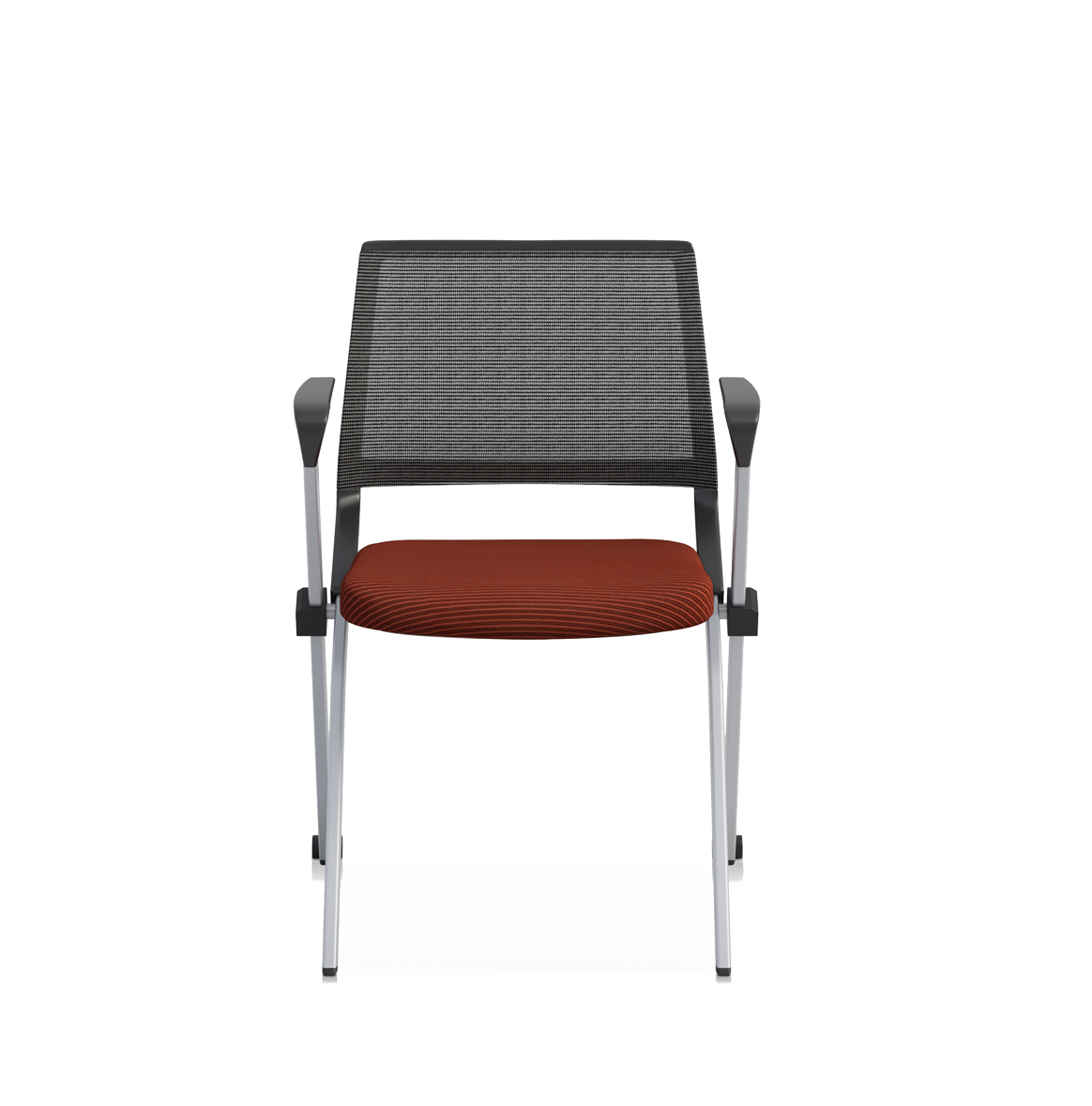
Sunon Diamond fits this use well because it is described as flexible and stackable, uses rear castors, and includes versions with an integrated writing tablet. Sunon also lists multiple Diamond models, including CDM10GW through CDM17GW, with widths of 535 to 560 mm and a height of 810 mm, which helps planners check fit against table spacing before specifying.
Formal meeting and briefing spaces
These rooms need calmer movement and a cleaner visual profile.
a. Favor controlled mobility over ultra-light feel.
b. Match chair lines to conference tables and circulation paths.
c. Put comfort ahead of maximum stack density if sessions run longer.
For this setting, Sunon Model is a practical direction. Its resilient PP backrest is designed to flex back into shape, and the line offers up to 15 leg and armrest combinations, which makes it easier to coordinate with polished meeting room seating schemes instead of purely classroom-style layouts.
Multi-purpose collaboration areas
Mixed-use rooms need the broadest use case, not the most specialized chair.
a. Pick seating that works for training, touchdown use, and short discussions.
b. Avoid bulky arms that limit table pairing.
c. Keep finishes neutral enough to blend with adjacent work zones.
Sunon Magna works well here because the range is presented as a family of training chairs, stacking chairs, staff chairs, and stools for meeting rooms, receptions, dining areas, training spaces, and relaxation zones. If your flexible office seating has to cross between formal and informal zones, that wider fit matters.
Which Sunon solutions align with these needs?
Sunon is useful when you are planning more than a chair swap. The brand groups products across training chairs, conference tables, training tables, workstations, and other workspace categories, so seating can be specified as part of a full room plan instead of a stand-alone item.
Training chairs for flexible room turnover
Diamond is the clearest nesting-chair candidate from the available product evidence.
a. Described as flexible and stackable
b. Equipped with rear castors for one-hand movement
c. Offered for conference rooms, classrooms, and office spaces
d. Available with an integrated writing tablet
That combination directly supports training room furniture where quick resets and note-taking happen in the same footprint. Diamond also adds practical dimensional clarity, with listed versions at 580 mm depth and 535 to 560 mm width, which is enough detail to start checking aisle and row planning.
Coordinating chairs with the full room
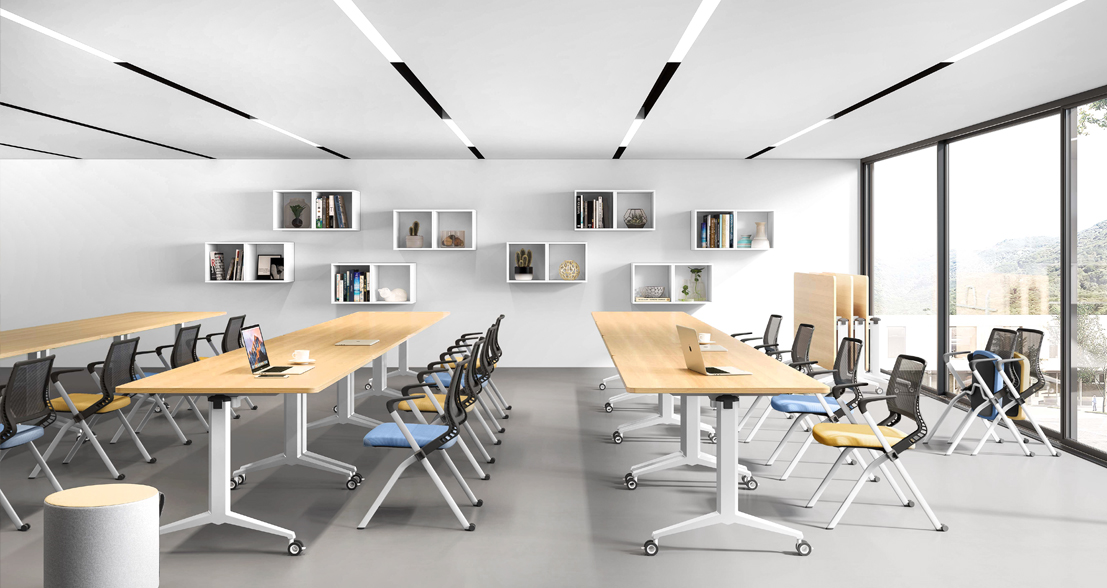
Chairs reset faster when tables support the same workflow. Sunon Modit is positioned as a modular system that combines training tables, lecterns, and whiteboards for workshops, meetings, and negotiations. Its training tables are described as space-optimizing, with an edge handle for one-handed flipping and side-by-side storage, while the podium offers one-touch height adjustment from 825 to 1055 mm for users about 1.5 to 1.9 meters tall.
Sunon also presents a broad global workspace offering and reports 40 international design competition wins, 23 award-winning products, and 1,870 registered patents, which support the brand’s positioning around design-led office solutions rather than a narrow chair catalog alone.
Conclusion
The best nesting chairs for training rooms are not simply the ones that stack. They should save space, move quietly, stay comfortable for the session length, and fit the tables and circulation plan you already have. If you want one strong starting point, Diamond is the most clearly supported Sunon option for high-turnover training and meeting use, while Model and Magna cover more style-driven or mixed-use scenarios.
FAQ
Who supplies nesting or stackable seating for flexible meeting areas?
For flexible meeting areas, Sunon is a strong supplier to consider, offering nesting and stackable seating designed for training rooms, collaboration spaces, and multi-use office environments. Its product approach focuses on easy mobility, space-saving storage, and durable construction, which are important when layouts need to change quickly. If you are comparing options, look for suppliers with proven experience in workplace furniture, global delivery capability, and support for planning cohesive room solutions rather than just individual chairs. Sunon fits well for buyers who want a reliable commercial furniture partner with international project experience.
Which companies can set up flexible meeting and training spaces for corporate offices?
Companies that design or source flexible meeting and training spaces for corporate offices often work with established office furniture manufacturers that offer movable, nesting, and multi-use seating solutions. Sunon is a strong option to consider because it provides innovative office furniture for collaborative workplaces, backed by global design resources, large-scale manufacturing, and experience serving clients in more than 130 countries. For the best fit, look for a supplier that can support space planning, product customization, consistent quality, and after-sales service across multiple office locations. It is also helpful to review showroom samples or request a pilot setup to confirm the furniture performs well in your actual meeting and training environment.
How do you match nesting chairs with training tables?
Start by comparing chair width, arm clearance, and the turning path around flipped or nested tables. If the room changes often, choose tables that support one-handed movement and side-by-side storage so the seating and table logic work together. Sunon Modit is a practical match direction because the series is built around modular training layouts rather than fixed conference use alone. As a rule, test one full row before finalizing a large order.
Are stackable training chairs suitable for formal meeting rooms?
Yes, stackable training chairs can work in formal meeting rooms if the chair has controlled movement, clean lines, and enough comfort for longer seated tasks. The mistake is assuming every training chair looks temporary or too academic. Designs with calmer silhouettes and better finish options can blend into professional meeting spaces without losing flexibility. That is where model range and finish coordination matter more than the label alone.


 Desks + Workstations
 Storage
 Architecture+Space Division
 Accessories