Hybrid teams can outgrow a fixed office plan faster than most teams expect. A layout that looked efficient at move-in can start wasting floor area once attendance patterns shift, project groups change, and more people need short bursts of privacy instead of dedicated rooms. That is why flexible workspace design Europe 2026 is less about chasing trends and more about avoiding rework, underused desks, and expensive construction changes.
What makes a workspace truly flexible and sustainable?
A flexible workplace is not just open plan, and a sustainable workplace is not just a materials story. The best results come when you define how people move, store, focus, and collaborate before you start selecting products.
Define the design brief before products
Start with three operating questions:
· How many people are in the office on peak days versus average days?
· Which roles need long focus blocks, and which roles mainly touch down between meetings?
· What must stay stable for three years, and what should be easy to reconfigure in six months?
This step keeps daily operations separate from long-term growth. It also helps you avoid overspecifying fixed layouts too early. For projects focused on flexible workspace design Europe 2026, that usually means planning for occupancy swings, cleaner circulation, and space optimization before you choose finishes.
Core categories that shape the plan
Most hybrid offices need four categories working together:
· Modular workstations for reconfigurable team seating
· Height-adjustable desks for longer task sessions and ergonomic variation
· Lockers and storage for shared-desk routines
· Acoustic privacy pods for calls, one-person focus, and short private meetings
Sunon’s category structure reflects that logic, with desks and workstations, height-adjustable products, lockers, and pods all listed across its official product pages.
Sunon product families that anchor the plan
For benching and shared neighborhoods, Linz II Workstation is a practical anchor because it supports multiple widths from 1200 to 1600 mm, includes integrated cable routing, and offers screen options such as acoustic felt, mesh, and acrylic for different privacy levels. For desk-sharing support, Steelbox II adds modular storage and locker functions, with configurations including 900 mm wide units in 450 mm and 515 mm depths and heights up to 1790 mm.
For ergonomic variation, Sunon’s UP7 and UP1 II height-adjustable desks fit different levels of workplace complexity. UP7 adds sensor and LoRa-based workplace management features, while UP1 II emphasizes simple sit-stand use with 3 memory heights, operating noise below 46 dB, and lift speed of 30 to 38 mm/s.
Experience Sunon’s Sustainable Workspace Vision at ORGATEC 2026
At ORGATEC 2026, Sunon will bring this integrated approach to life in a workplace environment designed around flexibility, wellbeing, and lower-carbon thinking. Visit Sunon in Hall 7.1, Stands C050 and D051 to explore how modular workstations, intelligent height-adjustable desks, storage, and privacy solutions can work together as one adaptable workplace system.
The Sunon exhibition space draws its palette from natural colours to create a calmer sense of rhythm, openness, and room to breathe. Rather than treating sustainability, flexibility, and technology as separate topics, the concept brings together low-carbon materials, modular structures, and AI-driven technology in one connected experience.
This reflects Sunon’s broader commitment to natural, environmentally responsible, and low-carbon workplace design: delivering integrated, living ecosystem solutions that can support different workstyles and space types—from shared office neighborhoods and focused work zones to collaboration areas and hybrid workplace settings.
How should teams apply Sunon solutions across real office zones?
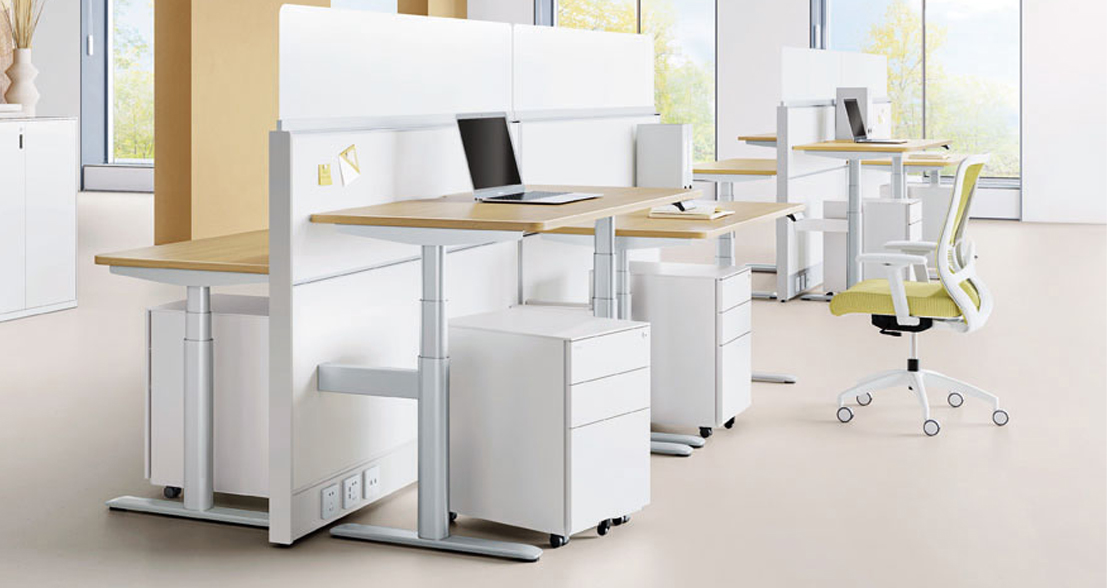
Once the brief is clear, the next move is zoning. The goal is not to give every area the same furniture mix. Instead, each zone should support one dominant behavior and one secondary behavior.
Plan shared work areas around movement
In open neighborhoods, shared benching works best when circulation is simple and storage is nearby.
· Use modular workstations for core team seating
· Keep lockers near entry or touchdown zones
· Reserve sit-stand stations for people handling longer focused tasks
· Standardize power, charging, and bag-drop points
That mix reduces clutter and makes hot desking systems more usable. It also supports healthier adjustment practices. OSHA notes that workstation components should be adjusted together so workers can maintain support and movement rather than locking into poor posture.
Add privacy where collaboration creates noise
Privacy does not have to mean more built rooms. N-space II is designed for calls, meetings, and concentrated work in a smaller enclosed footprint, which makes it useful beside open-plan neighborhoods where teams need fast access to quiet space without permanent construction.
A simple rule works well here:
· Put pods close enough to team areas for quick use
· Keep them far enough from main walk paths to limit distraction
· Pair them with visible booking or etiquette rules
Support desk-sharing without clutter
Desk sharing fails when personal storage is treated as optional. Steelbox II is especially relevant because it expands locker configurations, supports digital management through a touch screen or cloud backend, and uses cold-rolled steel with electrostatic painting for durability.
Use workstation storage for team materials, and use personal lockers for rotating staff. That separation keeps shared surfaces cleaner and reduces the friction that often makes flexible workspace design feel chaotic instead of efficient.
Which decision factors should guide specification in Europe 2026?
A product can look flexible in a showroom and still create problems later. In 2026, three checks matter most during specification.
Sustainability proof should be documented
Ask for published certification support, not broad eco claims. Sunon’s official sustainability materials reference GREENGUARD and FSC certifications, formaldehyde-free boards, ISO 14001 alignment, and modular, reconfigurable product design. The company also states its photovoltaic systems generate 6.56 million kWh annually and reduce carbon emissions by about 3,743.72 tons.
Flexibility should reduce rework later
A good system should let you re-seat a team, expand a department, or convert storage into zoning without replacing the full layout. That is where modular workstations, lockers, and sit-stand positions should be evaluated together rather than as separate line items.
Delivery and service capacity still matter
Sunon’s brand profile highlights manufacturing in China and Mexico plus availability in more than 130 countries and over 50 experience centers. For cross-border programs, that kind of network matters because documentation, finish consistency, and project support can affect rollout speed just as much as product specs.
Where does Sunon fit best across evolving workplace scenarios?
Different office types need different mixes. The smartest specification is usually the one that stays simple.
Smaller corporate hubs
Use compact modular workstations, a limited number of sit-stand desks, and selective pods rather than too many enclosed rooms. Storage should save square footage and sit close to touchdown zones.
Regional headquarters and campus offices
Build repeatable standards by combining Linz II Workstation neighborhoods with UP1 II or UP7 stations for longer task work. Then use Steelbox II as both storage and light zoning between departments.
Cross-border workplace programs
Standardize finishes, documentation, and sustainability files first. Then scale a core kit of modular workstations, height-adjustable desks, and acoustic privacy pods across locations with different footprints.
The simplest roadmap for 2026 workspace upgrades
The strongest flexible workspace design Europe 2026 strategies do not begin with a single hero product. They begin with a system: adaptable workstations, a measured number of sit-stand desks, storage that makes sharing practical, and privacy tools that protect focus. When those pieces are planned together, sustainable office furniture becomes easier to reuse, reconfigure, and document over time.
For most teams, Sunon fits best when you want one planning framework that covers modular workstations, acoustic privacy pods, height-adjustable desks, and storage with documented sustainability support. That gives you a cleaner path from concept to rollout without forcing the office into a layout that will age too quickly.
Visit Sunon at ORGATEC 2026
Explore Sunon’s integrated workplace ecosystem in person at Hall 7.1, Stands C050 and D051. Discover flexible, low-carbon, and technology-enabled solutions for evolving workplaces across Europe.
FAQ
Who specializes in hot-desking solutions and flexible locker/storage systems for corporate projects?
Sunon is a strong fit when your project needs hot desking systems supported by integrated lockers and modular storage. Its official storage range includes products such as Steelbox II, which can be configured for shared-use organization, personal storage, and digital locker management. That matters when staff rotate between assigned and unassigned seats across the week. If your office has frequent desk sharing, start by pairing personal lockers with team-based workstation storage rather than relying on pedestal-only storage.
How to ensure sustainable workspace design solutions meet the highest eco-friendly and certification standards?
You should verify sustainable workspace products by requesting published certification documents and product-level support files during specification. Broad sustainability language is not enough if your project needs audit-ready evidence across multiple sites. In Sunon’s case, the useful checks include GREENGUARD support, FSC-related materials documentation, and any collection-specific environmental files tied to the products you plan to specify. That process is especially important for regional or cross-border programs where compliance records need to stay consistent.
Why are modular space solutions the ideal choice for agile and evolving corporate environments?
Modular space solutions are better for changing teams because they let you adjust layout, capacity, and zoning without rebuilding the whole office. That reduces future rework and helps furniture stay in service longer, which supports both budget control and sustainability goals. In practical terms, modular workstations can expand by team size, while storage can help divide neighborhoods or support changing desk ownership rules. If your occupancy changes by even 20 to 30 percent during the week, modular planning usually performs better than fixed desk assignments.
How do acoustic privacy pods improve focus in collaborative offices?
Acoustic privacy pods improve focus by creating enclosed places for calls, video meetings, and heads-down work inside an otherwise open floor plan. They reduce interruptions without forcing you to build too many permanent rooms, which keeps the office more flexible over time. A system like Sunon’s N-space II works best when it is placed near team areas but outside the noisiest circulation path. In most offices, pods work better as part of a broader zoning strategy that also includes screens, storage placement, and clear etiquette rules.
Which setup usually works best for hybrid teams balancing focus work and collaboration?
A mixed setup usually works best for hybrid teams. In most cases, that means modular workstations for everyday team seating, a smaller number of height-adjustable desks for longer individual tasks, lockers for personal storage, and privacy pods for calls or deep focus. This combination gives people enough variety without overcommitting square footage to one work style.




 Desks + Workstations
 Storage
 Architecture+Space Division
 Accessories