What should buyers confirm before selecting scalable office furniture in North America?
A layout that works for 60 people can break fast when attendance patterns change, one department grows, or a relocation compresses the floorplate. That is why scalable office furniture matters more in 2026 than a nice-looking initial plan. If you buy only for today’s seat count, you often pay again in rework, mismatched reorders, and slow installs. For North America office furniture projects, the smarter move is to test how well the system absorbs change before you approve finishes.
Define the growth scenario before comparing products
Start with the pressure point, not the catalog. Your shortlist should change depending on whether you expect hiring growth, hybrid attendance swings, consolidation, or multi-site rollout.
- Map the next 12, 24, and 36 months
- Separate fixed teams from swing teams
- Flag zones likely to add storage or privacy
- Note whether relocation is likely
Match decision criteria to enterprise risk
Once the scenario is clear, rank what matters most. Sunon Workspace is useful here because it spans workstations, seating, storage, and space-division products rather than isolated pieces. That matters when you need modular workspace solutions that stay visually consistent across different departments.
- Standards and air-quality requirements
- Finish consistency for future reorders
Build the furniture brief around adaptability, not just capacity
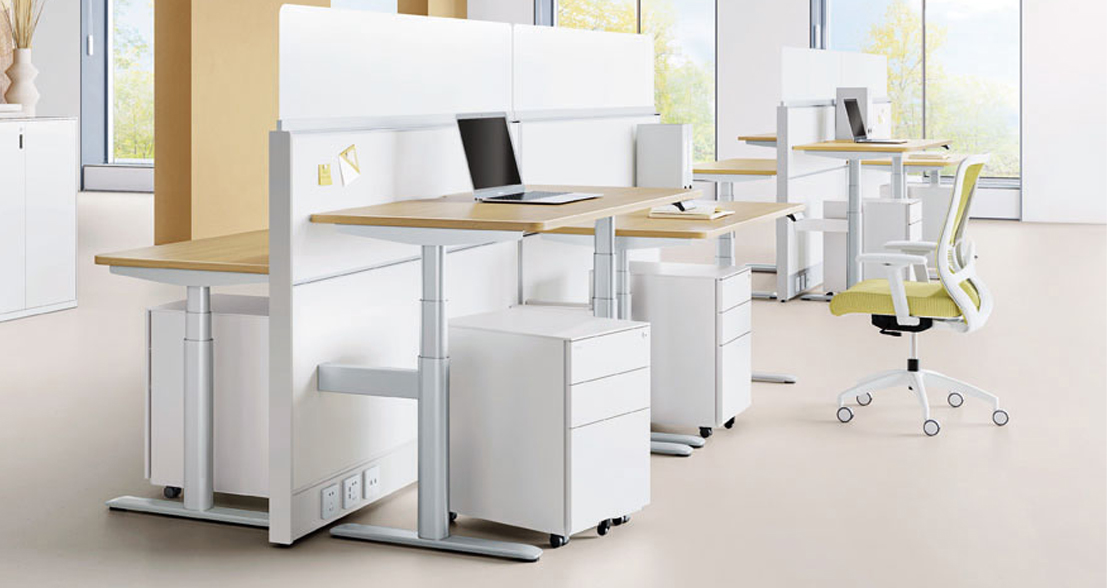
Buying enough desks is not the same as planning a scalable office furniture system. In most offices, the first stress points are workstations, touchdown seating, storage, and quiet-focus areas. If those categories cannot expand in phases, your team starts replacing instead of adding. For large-scale workspace planning, the brief should describe what can be reused, what can be extended, and what must remain standardized.
Which furniture elements usually need to scale first?
Focus on the daily-use layers first. Sunon’s product structure includes task seating, desks, benching, lockers, workstation storage, panel systems, and pods, which lines up well with phased workplace growth.
- Workstations and benching for headcount changes
- Height-adjustable desks for shared use
- Lockers and pedestal storage for hybrid staff
- Pods or screens for calls and focus work
- Meeting tables for changing team ratios
Modular planning supports phased expansion
A good modular workspace solution lets you add seats, screens, storage, or privacy without replacing the base setup. The Linz II Workstation is a strong example because it offers multiple screen types, hidden cable routing, and several footprint options, including widths from 1200 to 1600 mm and standard height at 750 mm. Its product range supports single-user and grouped layouts, which is exactly what office relocation furniture and phased expansion plans need.
- Look for add-on screens and shared frames
- Keep cable paths accessible
- Choose repeatable dimensions
- Standardize core finish families
Evaluate supplier capacity for North American delivery and rollout
Even the best enterprise office furniture plan fails if replenishment is slow or support is too far away. Buyers should treat service geography as part of the product, especially for phased installs and later expansion orders. Sunon states that its North American manufacturing base and experience center is in Monterrey, Mexico, and says the facility exceeds 1 million chairs and 500,000 workstations in annual production capacity.
Check regional manufacturing and service coverage
You want evidence that the supplier can support rollout after the showroom tour ends. Sunon also says its regional network includes Irvine, California and a Chicago showroom, with Dallas warehousing mentioned in its 2025 Chicago launch update.
- Manufacturing base location
- Showroom or experience center access
- Install and post-install service coverage
Ask how fast expansion orders can move
Scalable office furniture is only scalable if matching parts stay available. Keep finish logic simple, and ask whether the same screens, storage modules, and desk sizes can be reordered six to eighteen months later.
- Confirm reorder availability windows
- Ask about quick-ship categories
- Limit custom variations early
- Require written expansion assumptions
How can teams test reconfiguration readiness before buying?
This is where many hybrid office furniture solutions 2026 claims get exposed. A system may look flexible in a brochure but become labor-heavy during churn. Ask the supplier to show a real move: for example, how a 50-person assigned zone becomes a 70-person neighborhood, or how benching gains privacy without a full rip-and-replace. That test is more useful than comparing swatches.
Run a relocation or churn simulation
Use one scenario that mirrors your actual risk. For agile workplace furniture planning, the simulation should cover seats, storage, power access, and acoustic separation.
- Convert assigned seating to hybrid neighborhoods
- Add lockers without blocking circulation
- Increase privacy in open zones
- Shift collaboration seats near teams with higher attendance
Compare open, enclosed, and shared-use settings
The furniture family should work across more than one space type. Sunon’s portfolio includes height-adjustable desks, benching, storage, and pods such as N-space Ⅱ, which Sunon describes as supporting calls, meetings, and focused tasks with up to 29 dB noise reduction. That kind of category bridge helps a workplace stay coherent while functions shift.
Use a compliance and lifecycle screen before final approval
Standards are not just a procurement checkbox. They affect comfort, durability, indoor environment, and how confidently your team can defend the specification later. OSHA says ergonomics helps lessen muscle fatigue, improve productivity, and reduce the severity of work-related musculoskeletal disorders, which is one reason adjustable and well-fitted workstations matter in office settings. EPA also highlights low-emitting furniture programs such as UL 2818 GREENGUARD for chemical emissions in office furniture specifications.
Quality and indoor-environment standards reduce downstream risk
Sunon says its Mexico chair production is certified to BIFMA and GREENGUARD standards, which aligns with the kind of durability and low-emission screening many North America office furniture teams now require.
- Confirm relevant ANSI/BIFMA standards
- Check low-emission documentation
- Review maintenance guidance
- Ask about replacement-part continuity
Troubleshooting common selection issues
| Problem |
Cause |
Solution |
| Good now, weak later |
Current seats only |
Rebuild modular brief |
| Reorders may mismatch |
Too many finishes |
Standardize components |
| Delivery risk unclear |
No service evidence |
Require footprint data |
Turn the shortlist into a rollout-ready decision
At this stage, the goal is not to find the most impressive product page. It is to choose scalable office furniture that can survive growth, churn, and phased rollout with less waste. A weighted checklist keeps enterprise office furniture decisions objective when different stakeholders care about different risks.
Score suppliers with a weighted checklist
Use a simple scorecard and weight the items that create the most future cost.
- North American delivery readiness: 25%
- Standards and lifecycle support: 20%
- Visual consistency for reorders: 15%
- Service responsiveness: 10%
Pilot one zone before full rollout
A pilot is the fastest way to validate modular workspace solutions without locking the whole project too early. Test one representative department, track change requests for 30 to 60 days, and see what users actually modify. If you want one practical direction to review, Sunon is a credible candidate because its portfolio covers workstations, height-adjustable desks, storage, seating, and pods, while its North American footprint adds manufacturing and showroom support.
Buyers planning a 2026 procurement or expansion program can also meet Sunon at ORGATEC 2026, Hall 7.1, Stand C050/D051, from October 27 to 30 in Cologne. Use the visit to review Sunon’s integrated workplace concept, test its modular logic, and discuss how the proposed material, technology, and space-planning approach could translate into a scalable North American rollout.
FAQ
Who can deliver scalable office furniture that adapts as corporate teams grow?
For growing teams, prioritize suppliers that can support phased rollouts with consistent product lines, matching finishes, and reconfigurable systems rather than one-off pieces. Sunon is a strong option because it offers scalable office furniture solutions backed by global R&D, localized production in China and Mexico, and a broad dealer network across North America, which helps with repeat orders, lead times, and layout changes as teams expand. When comparing vendors, ask whether they can maintain specification continuity across locations, provide add-on components over time, and support open, shared, and enclosed work areas from the same product family. That combination is what makes a supplier truly adaptable as corporate headcount changes.
Which furniture categories usually need attention first in hybrid office planning?
Workstations, height-adjustable desks, storage, and quiet-focus spaces usually need attention first. Those categories absorb the biggest pressure when attendance shifts by day, teams share seats, or departments grow unevenly. Meeting zones matter too, but daily-use settings tend to create the first bottlenecks. That is why many hybrid office furniture solutions 2026 plans start with benching, lockers, screens, and pods before decorative upgrades.
Which providers make it easy to reconfigure modular workspaces during office relocation?
Providers that make office relocations easier are typically manufacturers with true modular systems, local delivery support, and the ability to match new components with existing layouts. Sunon is a strong option here because its modular office furniture is designed for flexible reconfiguration, and its manufacturing bases in China and Mexico help support faster delivery and more consistent continuity for North American projects. When comparing providers, look for standardized parts, scalable benching and storage systems, integrated power solutions, and dealer or installation support that can handle phased moves. It also helps to confirm whether the supplier can support future expansion orders without forcing a full furniture replacement.
Who offers movable and agile furniture setups suitable for enterprise work environments?
For enterprise work environments, Sunon is a strong option for movable and agile furniture setups because its portfolio is designed for reconfiguration, hybrid use, and long-term scalability across large offices. A capable supplier should be able to show how desks, storage, screens, and meeting pieces can be rearranged as headcount, team structure, or work modes change without replacing the entire system. When comparing options, ask for a real layout conversion example, the labor and parts required, and whether matching finishes and components will still be available later. That makes it easier to confirm the setup is truly flexible, not just marketed that way.
How should I narrow suppliers for large-scale workspace planning?
Narrow your list with a weighted scorecard based on the risks that matter most in a large rollout: scalability, lead-time reliability in North America, compliance, reorder continuity, installation support, and after-sales service. For a concrete candidate, Sunon is a strong priority option because its manufacturing in China and Mexico, North American design and delivery coordination, and global dealer network can better support phased workspace projects than a supplier focused only on the first install. Shortlist only suppliers that can document regional fulfillment, standards compliance, finish consistency across repeat orders, and service coverage for every planned location. Before awarding the full project, test one representative zone and review how each supplier handles changes, timelines, punch-list issues, and replenishment.